
Why do Honey Bees swarm?
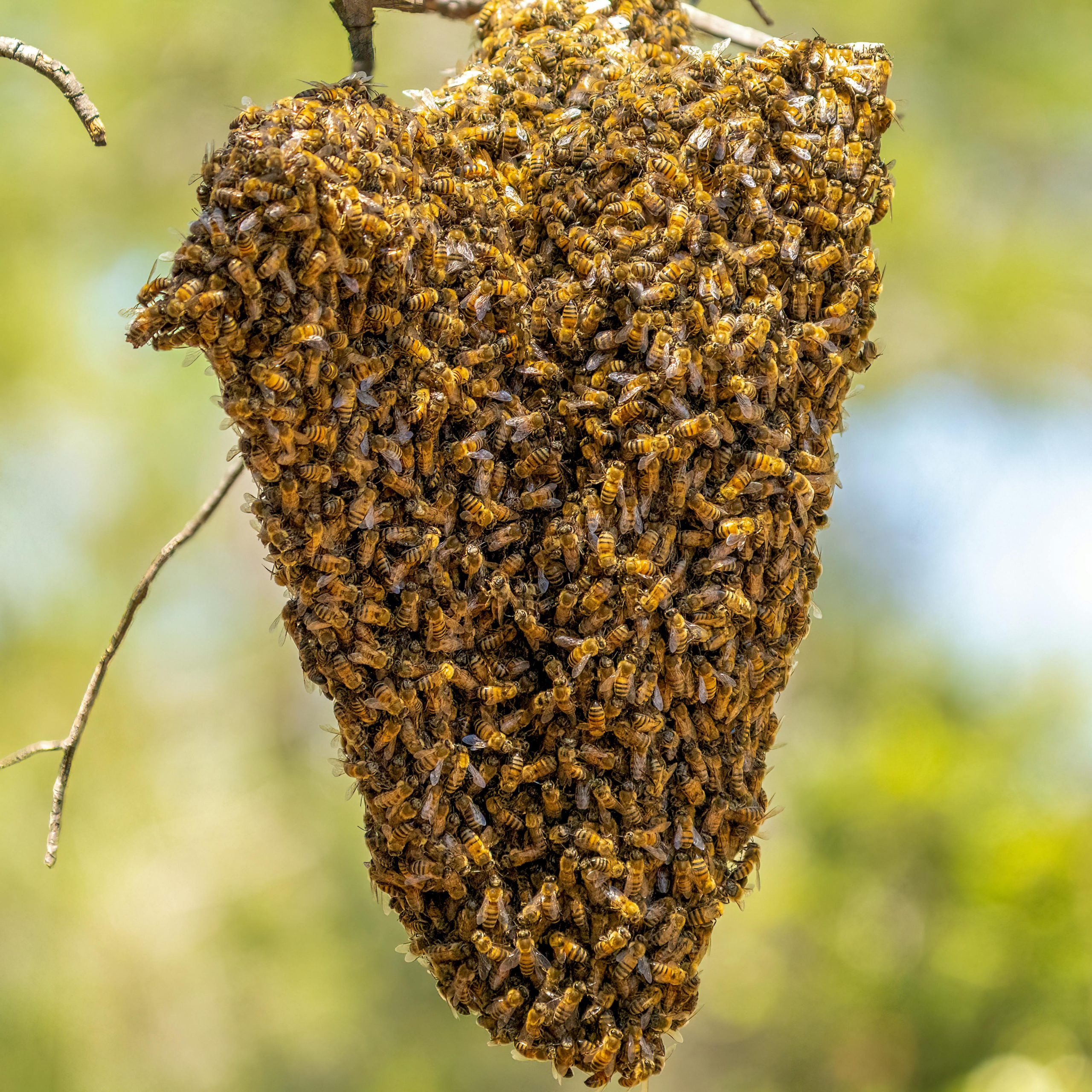
Honey bee swarming is the colony’s natural way of reproducing: as spring advances and the hive becomes crowded with bees, brood, and stored nectar, workers begin raising new queens, prompting the old queen to slim down and leave with thousands of bees to establish a new nest.
Although a swarm in flight can look dramatic, the bees are usually calm because they are focused on staying with their queen rather than defending a hive. After a short flight they cluster temporarily on a branch or similar surface while scout bees search for a suitable new home, during which time they are generally docile but still best observed from a safe distance.
If a swarm is encountered, the safest action is to go indoors, close windows and doors, and allow the bees to settle and contact a local beekeeper who can collect and relocate them.
You can locate a local beekeeper using the BBKA’s Find a local Swarm Collector.
Questions a beekeeper may ask:
- Describe what you have seen or ideally send a picture.
- Size of cluster (e.g. football size etc.) Honey bee swarms are thousands of bees not a dozen or so.
- Location and access (indoors, outdoors, chimney, etc).
- Height (e.g.1st floor, roof top).
- How long have they been there
- Have you called anyone else
- Address/directions/parking including postcode
- Contact number
- Please call the beekeeper back if the swarm leaves before they arrive or if someone else collects it to save a wasted journey.
- Do not give multiple beekeepers the details once one has agreed to attend.
Things to note:
- Beekeepers collect swarms on a voluntary basis; they are NOT paid to provide this service although some beekeepers may ask for expenses.
- The beekeeper may not be able to come immediately; they may have jobs and commitments of their own.
- Beekeepers must consider their own safety; it may not be possible to remove a swarm from difficult-to-reach places.
- Please don’t use chemicals or other products on them.
- Bumblebees are best left alone. They are valuable pollinators, some are endangered. Don’t try to block entrance holes as they will try to find another way out possibly into the property. They will die out naturally in late summer/autumn.
- Wasps may require a pest controller if in a dangerous position. Wasps are also good pollinators and eat pests in your garden. Beekeepers don’t remove wasps.
- If on arrival the beekeeper finds that it is not honey bees then they are unlikely to be able to help.
If you have bees on your premises
It is important to identify them correctly to determine who to approach for help. As well as honey bees there are around 24 species of bumblebee and over 240 species of solitary bee in the UK. Visit the British Beekeeping Association (BBKA) Identification page for more information.
Honey Bee Stings
Female honey bees, both workers and queens, possess a sting, which the workers use to defend their colony. The queen seldom uses her sting on humans and drone (male) honey bees do not possess a sting. The worker sting usually detaches from the worker bee when they sting a human, leaving the sting in the victim and the bee often dying. The sting comprises a venom gland and sac, which continues to pump venom even after the sting has become detached from the bee.
To treat bee stings, follow these steps:
- Remove the stinger: calmly remove the stinger as soon as possible to prevent more venom from entering the body. It is better to ‘scrape’ the stinger out
- Wash the area: Clean the sting site with soap and water to reduce the risk of infection.
- Apply ice: Use an ice pack or a cold compress on the affected area for 15-20 minutes to help reduce swelling.
- Take pain relief: Over-the-counter painkillers can help alleviate pain.
- Use antihistamines: If itching or swelling occurs, antihistamines can help relieve these symptoms.
- Stings to the eyes: Seek prompt medical assistance
- Bee stings to the airwaves (e.g. throat or tongue) should be treated as a medical emergency. Call 999
For most people bee stings cause temporary localised pain, swelling and redness. These symptoms generally reduce over 48 hours. However, those with an allergy to bee venom may experience anaphylaxis.
Anaphylaxis (pronounced ana-fil-ax-is) is a life-threatening allergic reaction that happens very quickly and usually start within minutes of being stung. Symptoms can include:
- difficulty in breathing with wheezing or noisy airway
- coughing
- swelling of tongue and throat with puffiness around eyes
- confusion and agitation
- signs of shock leading to collapse and unresponsiveness
If you suspect someone is having serious allergic reaction or you know they are allergic to be stings, call 999 for an ambulance immediately and tell them you suspect Anaphylaxis.
For more information on Anaphylaxis, visit Anaphylaxis UK or the NHS website
For more information on treating stings visit the NHS Insect bites and stings page